CRIDGE: A Service to manage Custom Resources in a Kubernetes Cluster
Introduction
Kubernetes is an orchestration system for automating software deployment, scaling, and management. One can interact though the Kubernetes API and it has a set of objects ready for use out of the box. Custom Resource Definitions (CRDs) is a way that allows to manage things other than Kubernetes itself and allows to create our own objects The use of CRDs makes the possibilities of Kubernetes management almost limitless. You can extend the base Kubernetes API with any object you like using CRDs.
CRIDGE is a service designed to create and manage Custom Resources (CRs) based on Custom Resource Definitions (CRDs) installed on a Kubernetes cluster. By leveraging OpenSlice (OSL), CRIDGE enables seamless integration and orchestration within Kubernetes environments, utilizing Kubernetes APIs via the TMF APIs and models. Thus, more or less, OSL exposes Kubernetes APIs as TMF APIs and models.
By allowing the design and lifecycle management of services/resources that expose CRDs/CRs in a Kubernetes cluster via the TMF APIs, OSL can be used in many complex scenarios now involing resources from multiple domains.
Pros, in a nutshell:
-
Enabling Loose Coupling and Orchestration
- Language Flexibility: Developers can write CRDs in any language and expose them via the Kubernetes APIs. OSL will reuse these CRDs, enhancing flexibility and integration capabilities.
- Familiar Deployment: Developers can create and deploy applications using familiar tools such as Helm charts, simplifying the process and reducing the learning curve.
-
Ecosystem Reusability
- CRIDGE capitalizes on the extensive Kubernetes ecosystem, particularly focusing on operators (CRDs).
- Key repositories and hubs such as artifacthub.io and Operatorhub.io can be utilized for finding and deploying operators.
-
Service Catalog Exposure and Deployment
OSL can expose CRs in service catalogs, facilitating their deployment in complex scenarios. These scenarios may include service bundles that involve multiple systems, such as RAN controllers or other Kubernetes clusters, providing a robust and versatile deployment framework.
Why the CRIDGE name? We wanted to build a service that maps TMF models to CRDs; a kind of a CRD to TMF bridge. Therefore CRIDGE was born.
Approach
OSL in general is responsible for exposing Service Specifications which are ready to be ordered and orchestrated, through TMFORUM Open APIs as defined in the OSL Service Spec Catalog. Usually for a service specification a corresponding (one or more) Resource Specification (resourceSpecificationReference) is registered in the OSL Resource Spec Catalog.
The following image illustrates the approach.
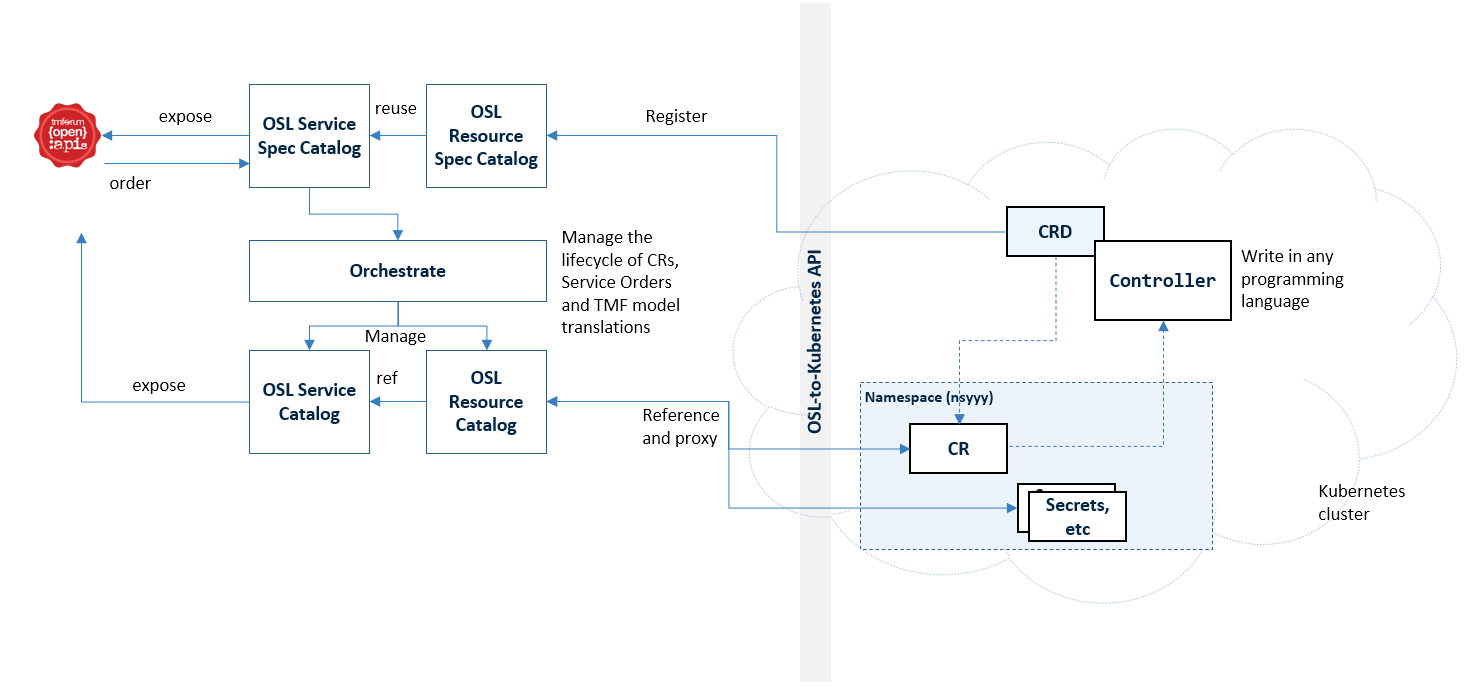
- A CRD in a cluster will be mapped in TMF model as a Resource specification and therefore can be exposed as a service specification in a catalog
- Service Orders can be created for this service specification. The OSL Orchestrator (OSOM) will manage the lifecycle of the Service Order.
- OSOM creates a Resource in OSL Resource inventory and requests (via CRIDGE) a new Custom Resource (CR) in the target cluster
- The resource is created in a specific namespace (for example the UUID of the Service Order)
- A CR in a cluster will be mapped in TMF model as a Resource in the resource Inventory
- Other related resources created by the CRD Controller within the namespace are automatically created in OSL Resource Inventory under the same Service Order
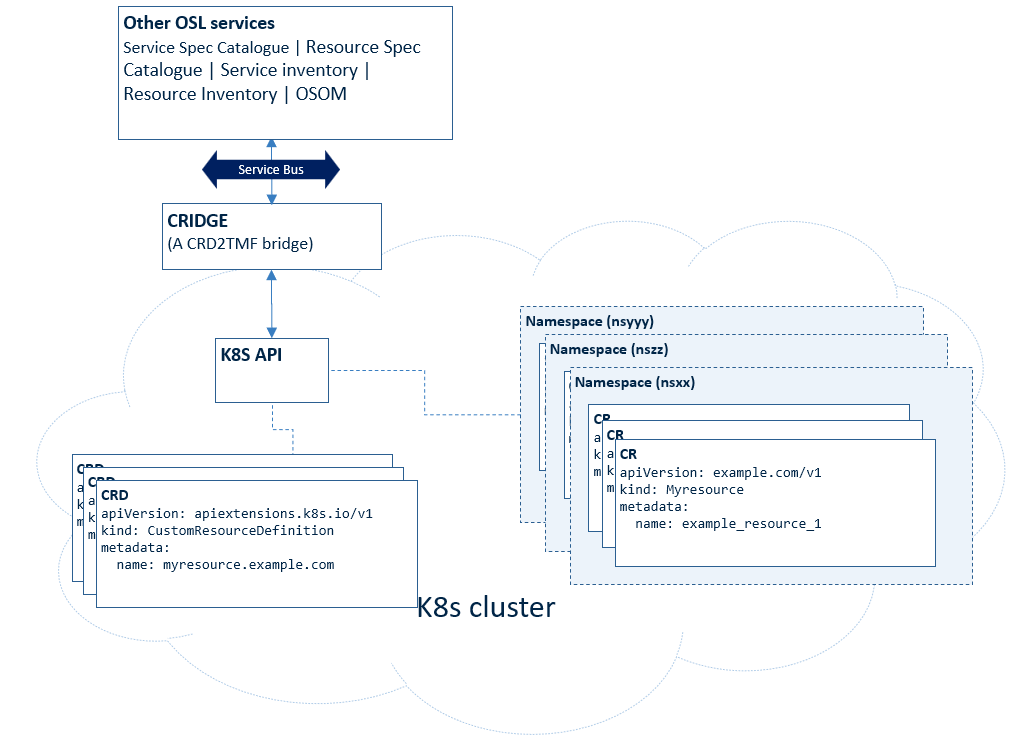
The provided image illustrates the architecture and workflow of the CRIDGE service, showing how it interacts with other components within a Kubernetes (K8s) cluster.
Following, there is an explanation of the key components and flow in the diagram:
- Other OSL Services: This box represents various OSL services such as Service Spec Catalogue, Resource Spec Catalogue, Service Inventory, Resource Inventory, and OSOM (OpenSlice Service Orchestration and Management).
- Service Bus: This is the communication layer that facilitates interaction between the CRIDGE service and other OSL services.
- CRIDGE: CRIDGE acts as a bridge that converts CRDs (Custom Resource Definitions) to TMF (TM Forum) APIs and models. It enables the creation and management of Custom Resources (CRs) in the Kubernetes cluster.
-
K8s API: The Kubernetes API server, which is the central control point for managing the Kubernetes cluster. CRIDGE interacts with the K8s API to manage CRDs and CRs.
CRD (Custom Resource Definition): A CRD is a way to define custom resources in Kubernetes cluster-wise. It allows the extension of Kubernetes API to create and manage user-defined resources. Example :
-
Namespaces: Kubernetes namespaces provide a way to partition resources within a cluster. The diagram shows that multiple namespaces (nsxx, nsyy, nsz) can be managed by CRIDGE.
CR (Custom Resource): A CR is an instance of a CRD. It represents the actual custom resource that is managed within the Kubernetes cluster. Example shown in different namespaces:
The example CRD myresource.example.com allows the creation of custom resources of type Myresource. Instances of Myresource are created in various namespaces, each with unique names like example_resource_1.
Mupliple Clusters Management
A CRIDGE service is usually responsible for managing one cluster. In the following diagram we show how it can be used for managing multiple clusters:
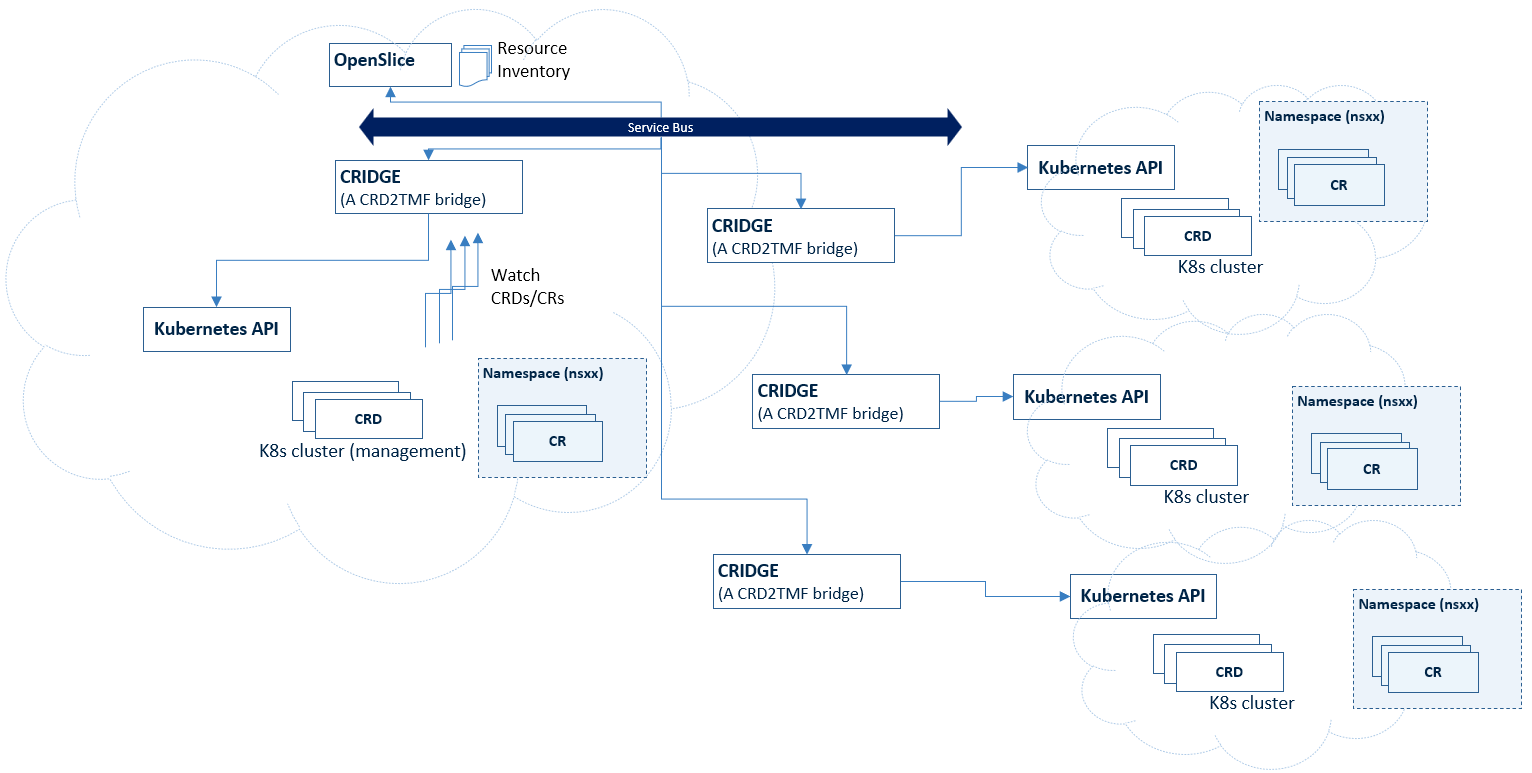
We assume that there is an OSL Management cluster that OSL is installed. CRIDGE is also installed there if we would like to manage resources in the same management cluster.
- Each CRIDGE service has its own configuration to connect to target cluster
- Each CRIDGE can be installed either in the managed cluster or at the remote clusters. Connectivity is handled via the service bus.
- Important: Each CRIDGE has a different context and API endpoints. This is used to request CRDs on a different cluster.
A CRD has a globally unique name for example mycrd.example.com. So we need to somehow identify also the different cluster.
Awareness for CRDs and CRs in a Cluster
CRDs and CRs can appear (disappear) or change status at any time in a cluster. OSL Resource Inventory need to be aware of these events.
The implemented synchronization process is explained by the following diagram:
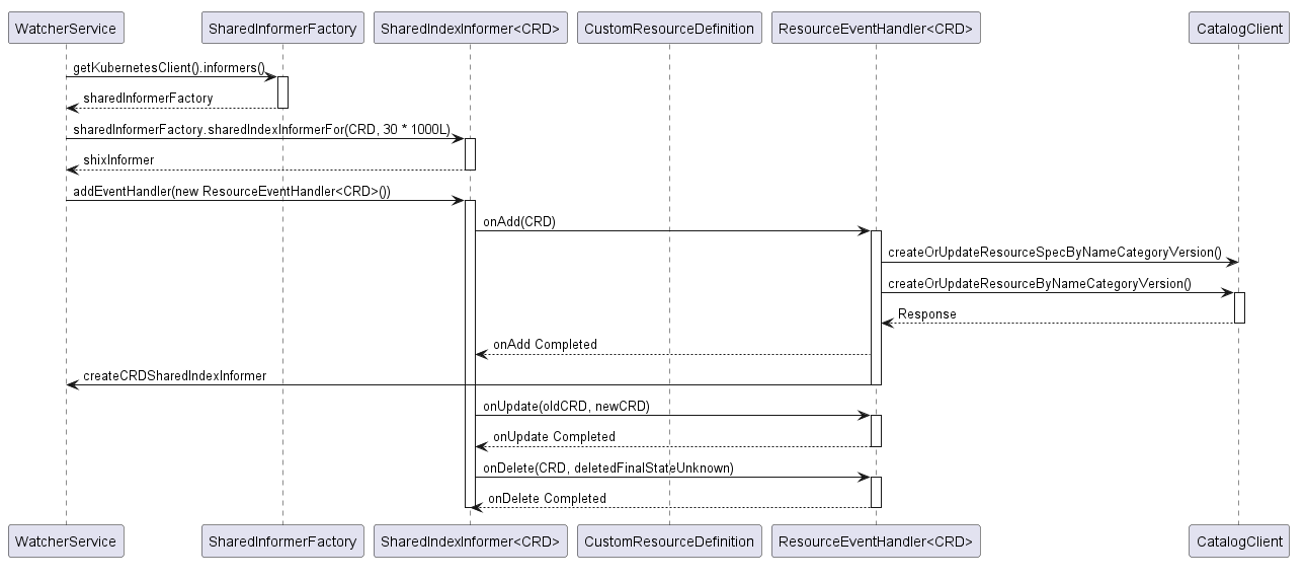
WatcherService is executed when the CRIDGE service application starts (see onApplicationEvent). Specifically:
- KubernetesClientResource is a class that wraps fabric8’s KubernetesClient
- This fabric8 KubernetesClient is initialized from the kubeconf and default context of the machine that runs CRIDGE
- On CRIDGE start-up we try to register this cluster and context to OSL catalogs.
- See registerKubernetesClientInOSLResource method which registers the KubernetesContextDefinition in Resource Inventory as a LogicalResource via createOrUpdateResourceByNameCategoryVersion method
- After the creation (or update) of this cluster as a Resource in OSL we proceed to create SharedIndexInformers for CustomResourceDefinition objects
- The SharedIndexInformer events notify CRIDGE, which is always aware of all CRDs and their CRs in the cluster, even if a CRD or CR is added/updated/deleted in the K8S cluster outside of OSL (CRIDGE)
- NOTE: The ADD event is raised every time also we run CRIDGE. Therefore, on ADD we do the method to createORupdate resource specifications and resources
- On ADD event:
- The CRD is transformed to OSL Kubernetes domain model: method kubernetesClientResource.KubernetesCRD2OpensliceCRD
- Then the OSL Kubernetes domain model is:
- Transformed to Resource Specification and is stored to catalog (see createOrUpdateResourceSpecByNameCategoryVersion)
- Transformed to Resource and is stored to catalog (see createOrUpdateResourceByNameCategoryVersion)
- Conceptually while a CRD is a new resource located in the Kubernetes cluster resource, it is transformed also as a Resource Specification (a high-level entity) which is ready to be reused as an entity to other scenarios. The same concept as in Kubernetes where a CRD is a definition ready to be used for instantiating resources of this CRD
- Then for this CRD a Watcher is added for all Resources of this Kind (fabric8’s GenericKubernetesResource entity)
- When we have a newly added/updated/deleted resource of a certain CRD the method updateGenericKubernetesResourceInOSLCatalog is called for this object (fabric8’s GenericKubernetesResource entity)
- We examine if the resource has label org.etsi.osl.resourceId
- This label is added by OSOM during service orders to correlate K8S requested resources with resources in inventory
- If the label exists, we update the resource by ID updateResourceById
- Else a resource is created in catalog
- A CR that is deleted from the cluster is reported with operationalState=DISABLE and administrativeState=SHUTDOWN
Exposure of CRDs as Service Specifications
See Exposing Kubernetes Resources section for ways to design services around CRDs.
Service Orchestration and CRDs/CRs
OSOM requests a CR deployment when the RFS has a _CR_SPEC characteristic (see Service Orchestration and CRDs/CRs).
How the CR lifecycle is mapped onto the TMF resource lifecycle through _CR_CHECK_FIELD and the _CR_CHECKVAL_* characteristics is described in Mapping the CR lifecycle.
OSOM sends CRIDGE a message with the following headers:
- currentContextCluster: current context of the cluster
- clusterMasterURL: current master URL of the cluster
- org.etsi.osl.serviceId: the id of the service the created resource refers to
- org.etsi.osl.resourceId: the id of the resource that the created CR wraps (one-to-one)
- org.etsi.osl.prefixName: a short prefix (default
cr) used in names, since K8s names cannot start with a number - org.etsi.osl.serviceOrderId: the related service order id
- org.etsi.osl.namespace: the requested namespace name
- org.etsi.osl.statusCheckFieldName: the value of
_CR_CHECK_FIELD - org.etsi.osl.statusCheckValue{Standby|Alarm|Available|Reserved|Unknown|Suspended}: the values of the equivalent
_CR_CHECKVAL_*resource status characteristics - org.etsi.osl.{adminStateCheckValue|operStateCheckValue|usageStateCheckValue|healthCheckValue}: the values of the equivalent
_CR_CHECKVAL_ADMINSTATE_*,_CR_CHECKVAL_OPERSTATE_*,_CR_CHECKVAL_USAGESTATE_*and_CR_CHECKVAL_HEALTH_*characteristics (e.g.org.etsi.osl.healthCheckValueUpcarries_CR_CHECKVAL_HEALTH_UP)
The message body is the _CR_SPEC (in JSON). CRIDGE replies "OK" on success, or "SEE OTHER" if another CRIDGE instance handles the target cluster. Any other reply is treated as an error.
CRIDGE then:
- creates the CR, adding the headers as labels
- watches the created resource(s) in the namespace (see the Sequence Diagram in previous images)
- reads the value of the check field and resolves it, using the labels, into:
- the resource
operationalState/administrativeState/usageState(ITU-T X.731), which drive the service lifecycle - the
resourceStatus, which is used for inventory / pool bookkeeping only
- the resource
- sends the resource to the message bus, to be created or updated in the TMF resource inventory
Deployment of a new CR based on a CRD
The implemented process to deploy a CR is explained by the following diagram:

- A message arrives to deploy a CR
- The call examines if this CRIDGE service can handle the request (based on context and masterURL)
- There are headers received and a _CR_SPEC in json
- The _CR_SPEC is unmarshaled as GenericKubernetesResource
- Headers are in format org.etsi.osl.*
- These headers are injected as labels (see Service Orchestration section)
- A namespace is created for this resource
- Watchers are created for this namespace for e.g. new secrets, config maps etc, so that they can be available back as resources to the Inventory of OSL
Probe further
See examples of exposing Kubernetes Operators as a Service via OpenSlice: