
OpenSlice 2026Q2 Release
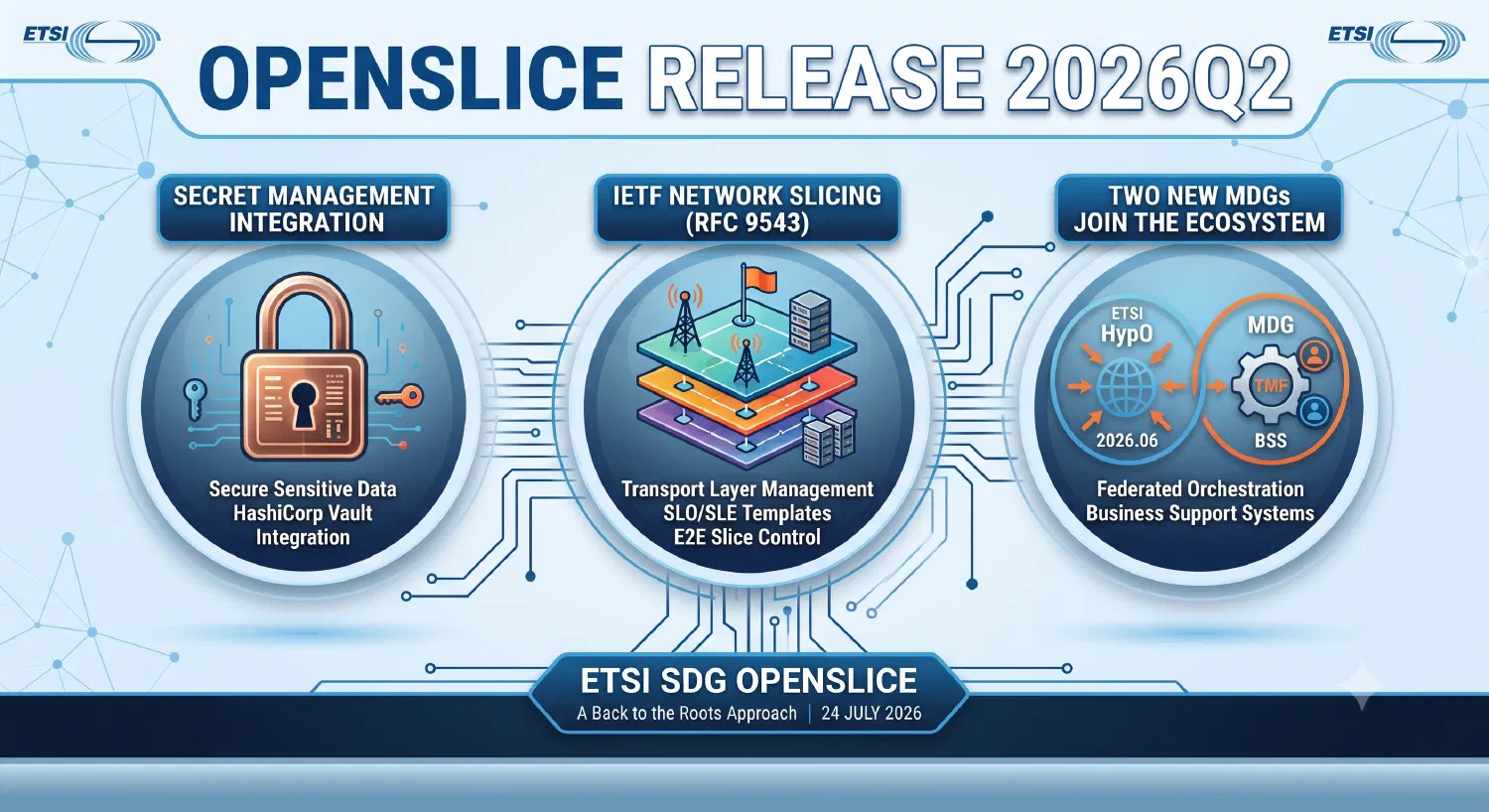
Release Date: 24 July 2026
We are proud to announce Release 2026Q2 of OpenSlice, developed and delivered by the ETSI Software Development Group for OpenSlice (SDG OSL).
Over the past two releases, OpenSlice has been at the forefront of operational AI integration, not just tracking advancements in the field, but purposefully embedding them into its operational core through the MCP Server, MCP Backend, AI Assistant, and Agentic Orchestration. We believe AI holds real promise, but for us it isn’t a buzzword. We know that is only as good as the foundational engineering underneath it.
That is why Release 2026Q2 marks a strategic “back to the roots” approach, strengthening the platform’s core capabilities and operational maturity. A key addition is the introduction of secret management functionality, enabling secure handling of sensitive data through integration with state-of-the-art identity-based secret management solutions. In parallel, we extend network control capabilities with a new IETF Network Slice Service (RFC 9543)-based controller, supporting end-to-end transport slice management. This controller integrates seamlessly with the fellow SDG TeraFlowSDN (TFS), particularly its MDG Network Slice Controller (NSC), acting as a natural consumer within a standards-aligned ecosystem.
Speaking of MDGs, we’re delighted to announce that this release goes beyond the core group. The OpenSlice ecosystem is expanding with two new MDGs, HypO and BSS, each tackling its own targeted aspects, and each rightfully deserving its own section in this announcement.
What’s New in OpenSlice 2026Q2
Secret management integration
OpenSlice can now handle sensitive data securely through integration with dedicated secret management solutions, starting with HashiCorp Vault. Secret data is protected at the exposure layer (UI & API) while remaining fully usable by the orchestrator.
IETF-based Network Slice Service controller
Another addition to network management: this controller implements the customer-facing part of the IETF RFC 9543 Network Slice Service, enabling the management of SLO/SLE templates and Network Slice Services.
MCP-level enhancements and latest version updates
An updated Spring AI version, refreshed notations, and new product-oriented tools.
Bug fixes
Multiple bug fixes improving the stability of deployment components and addressing issues identified since the previous release.
Architecture documentation enhancements
Updated architecture documentation, including a new OSL AI section and an upgrading guide.
How to try the Release 2026Q2
Experience the new features today by following our Deployment Guide.
Want to learn more?
ETSI HypO 2026.06 is here!
Hyper Orchestrator (HypO) is a mature orchestration platform, developed over several years, that enables federated service and resource orchestration through open standards, including TM Forum Service and Resource Management APIs.
Designed to complement OpenSlice, HypO operates as a Hyper Orchestrator above multiple OpenSlice deployments, enabling the creation of federated multi-domain ecosystems. It aggregates service offerings from independent OpenSlice instances into unified, TM Forum-compliant service catalogues, exposes them through a common marketplace, and establishes a trusted foundation for cross-domain service orchestration and federation.
Today, we are proud to announce its first open-source release as a new MDG within ETSI SDG OpenSlice.
This milestone marks HypO’s transition from proprietary development into an open, collaborative ecosystem where innovation is driven by the community.
The 2026.06 release introduces:
- A brand new CI/CD environment under ETSI’s infrastructure.
- Service and platform-level alert management through TMF642 Alarm API integration with Grafana Loki.
- Enhanced security through improved Keycloak and Vault integration.
- Improved integration with the open-source OpenZiti platform, providing a trusted and secure network fabric towards private infrastructures.
- Stability improvements.
- Expanded documentation and new workflow repositories supporting architecture-as-code.
By joining the OpenSlice ecosystem, HypO embraces transparency, interoperability, and vendor neutrality. We welcome researchers, developers, operators, and industry partners to evaluate the platform, contribute new capabilities, and help shape its future. Whether orchestrating cloud-native infrastructures, digital marketplaces, or multi-domain service ecosystems, HypO provides an open foundation built on industry standards. This release is the beginning of an exciting new chapter for the HypO community.
MDG BSS
OpenSlice has traditionally focused on OSS capabilities for delivering Network-as-a-Service (NaaS). Over time, it has evolved to also incorporate business-layer functionalities, including TM Forum Product APIs, product-oriented data models, business-facing interfaces, and AI-driven orchestration.
The newly formed MDG Business Support System (BSS) builds on this foundation. Its goal is to consolidate and mature these capabilities into a coherent framework that enables operators to address business, monetization, and service exposure challenges more effectively.
Rather than starting from scratch, MDG BSS leverages the existing OpenSlice codebase and models to develop standardized APIs, workflows, and orchestration mechanisms bridging OSS and BSS domains.
Supported by the ecosystem project COP-PILOT and our members and participants (Telefónica, UBITECH, p-NET, NetonomIQ, Instituto de Telecomunicações, and University of Patras), MDG BSS is intended to remain open, collaborative, and community-driven, encouraging contributions from both industry and research stakeholders.
About ETSI
ETSI provides members with an open and inclusive environment to support the timely development, ratification and testing of globally applicable standards for ICT-enabled systems, applications and services across all sectors of industry and society. We are a not-for-profit body with almost 900 member organizations worldwide, drawn from 64 countries and five continents. Members comprise a diversified pool of large and small private companies, research entities, academia, government and public organizations. ETSI is one of only three bodies officially recognized by the EU as a European Standards Organization (ESO).