
OpenSlice 2025Q4 Release
Release Date: 25 January 2026
We are proud to unveil Release 2025Q4 of OpenSlice, developed and delivered by the ETSI Software Development Group for OpenSlice (SDG OSL).
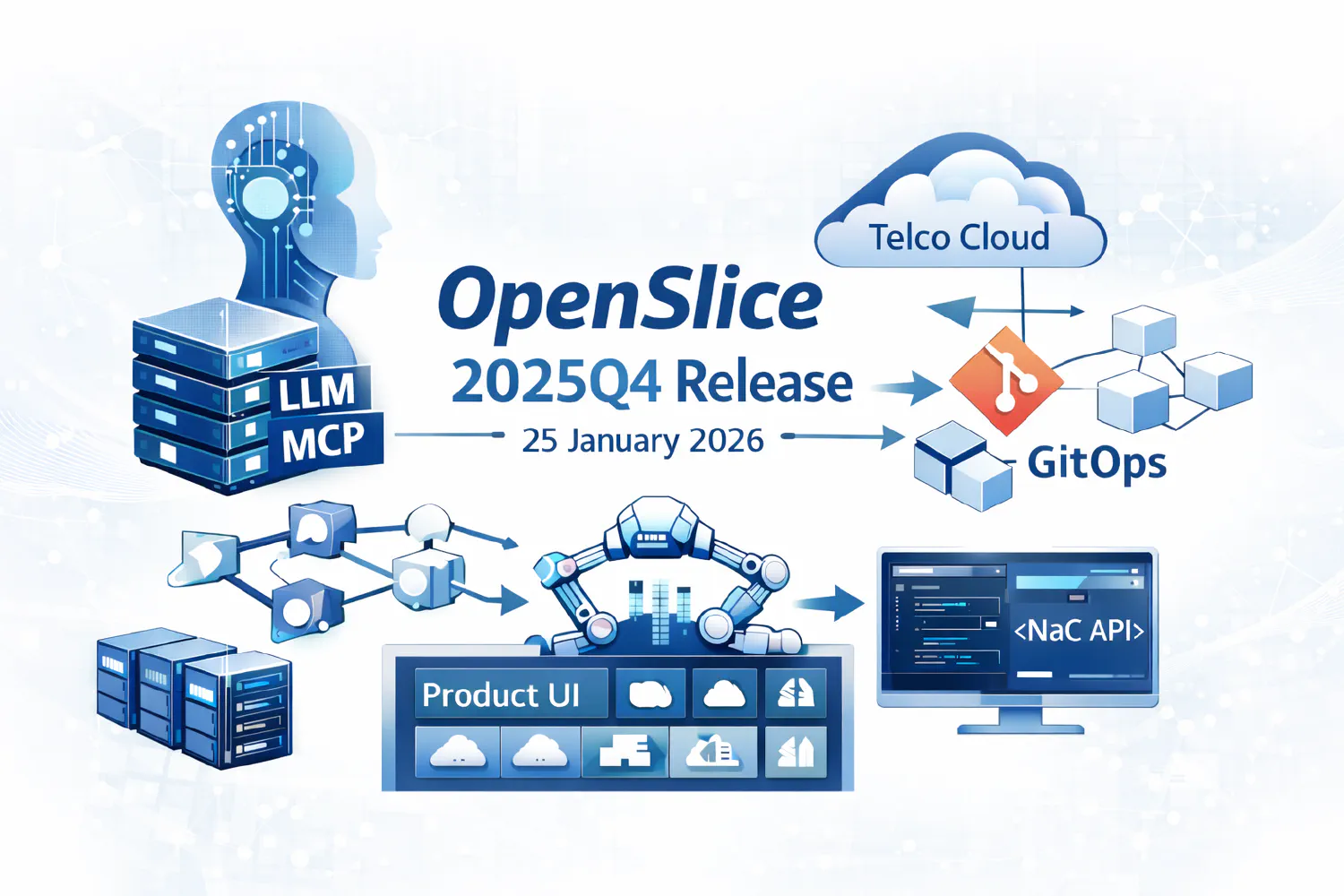
This release marks one of our most ambitious development cycles to date. We have pushed the boundaries of the modern telco landscape, integrating Agentic Orchestration, Local LLM deployments, an AI Assistant, and advanced Telco Cloud controllers into the OpenSlice ecosystem.
In 2025Q4, AI moves from the experimental periphery to the operational core. The OpenSlice MCP Server has matured way beyond its pilot phase, now featuring authentication and improved tool exposure. Driven by the need for data sovereignty and operational flexibility, we are introducing the OpenSlice MCP Backend. This new project natively integrates with the MCP Server but shifts the intelligence inward by leveraging local LLM deployments. Users can now connect to and fine-tune models within their own infrastructure. This stack powers the new OpenSlice AI Assistant, providing a seamless, chat-driven interface for platform tools. More importantly, we have implemented Agentic Orchestration. OpenSlice can now invoke a chain of internal or external Agents throughout the service lifecycle, transforming high-level insights into executable network actions. We see this as a critical milestone toward achieving true Autonomous Networks.
While AI takes center stage in this release, we have remained steadfast in our primary mission, delivering the network controllers essential to a true Telco Cloud vision. A key highlight is the introduction of Giter, a lightweight controller designed for asynchronous integration between distributed entities. By using Git as a coordination medium, Giter enables communication even in complex or intermittent environments. Alongside this, we have defined a new communication model that adheres to GitOps paradigm, not just managing infrastructure, but extending it to support cross-domain, inter-organizational, and air-gapped collaboration scenarios. Furthermore, we have successfully bridged the gap to Nokia’s Network-as-Code (NaC) platform. We developed a native controller that abstracts the NaC binary library through a REST API, effectively transforming its entities into TMF Resource Specifications and Resources. This integration ensures active synchronization, allowing the TMF ontology to be leveraged within standard OpenSlice orchestration processes.
Our push for cloud-native integration naturally led us to refine how these capabilities are exposed to the market. While our controllers enable as-a-Service (aaS) offerings, there is often a gap between technical resources and commercial products. Modern operators require more than orchestration; they need to foster federated marketplaces and product exchanges at a business logic level. To bridge this, we’ve introduced BSS extensions including a prototype Product UI built on our TMF Product API layer. This interface abstracts complex Telco Cloud resources into commercial products. By tightly coupling the BSS and OSS stacks, we ensure that a product selected in the UI automatically triggers the underlying cloud-native controllers, matching Telco Cloud agility with business-side flexibility.
To accelerate onboarding, we are launching a new repository of packaged service templates. New users can now import and deploy an indicative 5G Core service (complete with simulated subscribers) with minimal configuration, immediately upon installation. This “ready-to-run” example serves as a blueprint for the platform’s capabilities and significantly reduces the time from deployment to first-service-run.
What’s New in OpenSlice 2025Q2
AI-Native
Beyond the OpenSlice MCP Server updates, the new MCP Backend enables tool-calling via local LLMs, providing a private and secure foundation for the OpenSlice AI Assistant.
Agentic Orchestration
Orchestration enters a new era with the ability to invoke multiple autonomous agents during a service’s lifecycle, enabling multi-agent patterns that bridge the gap between intent and execution.
Telco Cloud Enhancements
New controllers now support GitOps-driven infrastructure management and native integration with Nokia’s NaC platform.
BSS & Product Management
A new prototype TMF Product UI allows for better visualization and management of the product layer, tightly coupled with the underlying OSS stack.
Ready-to-Deploy Blueprints
A dedicated repository of artifacts allows users to import and deploy complex services, such as a 5G Core, within minutes of setup.
How to try the Release 2025Q4
Experience the new features today by following our Deployment Guide.
Want to Learn More?
- Full Release Notes
- Software Documentation
- Meet the Team: Join us at the 2026 SNS4SNS event next week!
About ETSI
ETSI provides members with an open and inclusive environment to support the timely development, ratification and testing of globally applicable standards for ICT-enabled systems, applications and services across all sectors of industry and society. We are a not-for-profit body with almost 900 member organizations worldwide, drawn from 64 countries and five continents. Members comprise a diversified pool of large and small private companies, research entities, academia, government and public organizations. ETSI is one of only three bodies officially recognized by the EU as a European Standards Organization (ESO).